The Norwegian-listed financial service company K33, focused on serving institutional clients in the Scandinavian crypto world, recently released its annual Nordic Crypto Adoption Survey. The company’s research arm, K33 Research, has released these types of survey-based inquiries into Nordic crypto usage and adoption for a few years now and, as always, they seem very hopeful and optimistic about the Nordic region.
K33 itself mostly made news waves in the Bitcoin world last year with its somewhat unsuccessful participation in the Paper Bitcoin Summer craze. With some mid-100s BTC on its balance sheet (bitcointreasuries.net says 141, the company’s Q1 investor report, released yesterday, states 168 of BTC “exposure”), mostly acquired in July last year, the company stopped acquiring more coins as BTC/USD prices turned down and the mNAV arbitrage playbook stopped working.
That is, its financialization effort didn’t pan out, and now the company is pivoting to other market lines, including collateralized loans.
The report itself, authored by K33’s Head of Research Vetle Lunde, is fairly comprehensive, or at least as well done as can be expected for information-gathering efforts such as these. The 130-page report is filled with graphs and numbers covering crypto users in Finland, Sweden, Denmark, and Norway (plus a public presentation on Iceland, which it covered for the first time this year).
Surveys, generally speaking, have well-known scientific and statistical problems, particularly in noisy environments where people aren’t exactly eager to answer them. The problem gets orders of magnitude worse in the Bitcoin (and broader crypto) space where privacy is cherished and there’s no upside to confessing and advertising one’s holdings.
To be polite about it, what the survey finds is not at all representative of the population it is trying to describe.
Having said that, here are some of the juicier headline results:
- “2.5 million people in the Nordics own cryptocurrency, equating to 11.1% of the adult population.”
- “A meaningful share of the Nordic population has owned crypto in the past but no longer does. 6.8% of Norwegians, 7.4% of Swedes, 7.3% of Danes, and 9.2% of Finns report having exited the market.”
- “More young Nordics now own crypto than directly own stocks, with roughly 1.53 million crypto owners compared to 0.94 million equity owners in comparable age groups.”
Astonishing Progress for Bitcoin in the Nordics
At a glance, these results look incredible. Here’s BTChick, a Swedish bitcoin influencer, around the time of the report’s release:
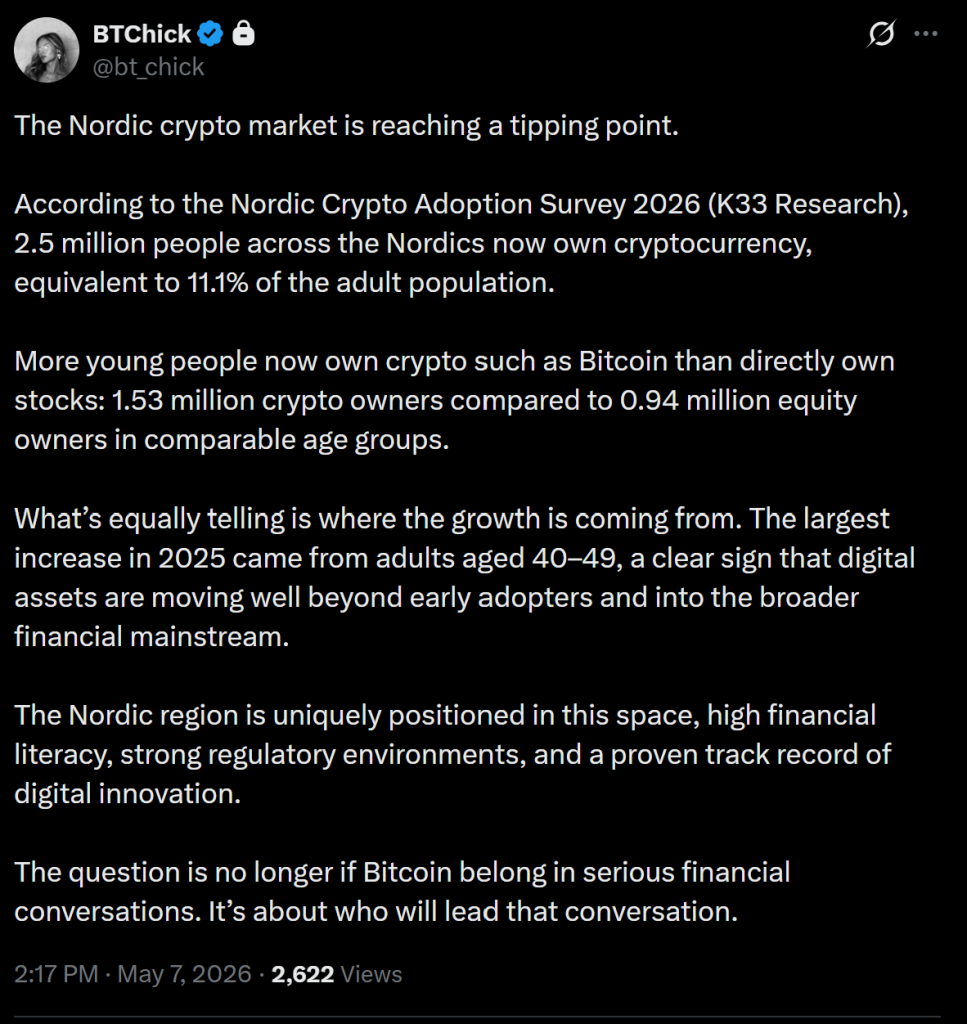
There’s no doubt that there’s some sort of gradual acceptance accompanied by increased adoption and financial flows. Spotted around Stockholm and in public transport in recent weeks are ads by Bitwise, a leading exchange-traded products provider that listed several funds on Nasdaq Stockholm this year, offering crypto exposure “without hassle.” In a talk at the Swedish Bitcoin Symposium 2026, Marco Poblete, Bitwise’s Nordic regional director, presented on the company’s goal of turning “Bitcoin haters into Bitcoin lovers.”
What the K33 Research reports have going for them is the consistent approach and long-term scope (relative to this industry, anyway). For whatever methodological flaws and faults it contains, comparison across years is pretty neat.; quite a lot of those figures go up and to the right.
How much of that is capturing a real trajectory rather than statistical noise or a normalization of a new asset class is hard to tell.
Besides, much murkiness hides behind these impressive headline claims. For example, to engineer the conclusion that “more” young Nordics own crypto than stocks, K33 Research had to explicitly exclude funds and pensions… only the most common and widely owned financial products in e.g., Sweden.
“We compare self-reported crypto ownership with register-based holdings of listed shares. Figures exclude funds, pensions and some brokerage structures.”
The 2.5-million figure, or 11% of the Nordic population, is literally unbelievable. Surveying the reported distribution of holdings makes clear how they arrived at that number: Most are trivial (“modest”) holders.
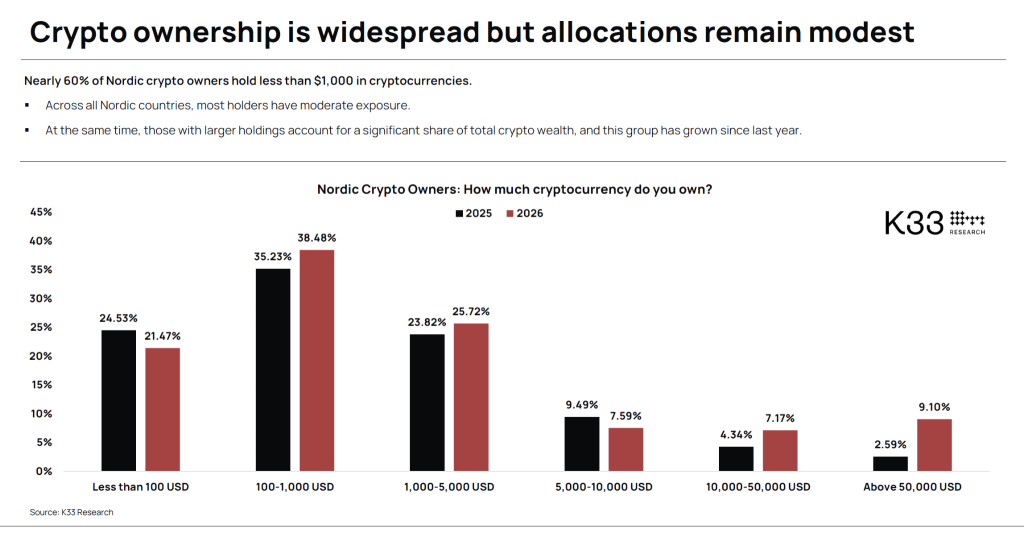
Most of the survey respondents who indicate positive holdings (some 386 people…), report trivial holdings (below 6 million sats). This looks much more like a side-hustle gambling on shitcoins, or some premine allocation, an airdrop receipt, or an online influencer promotion payment than it does consistent, regular stacking by a devoted set of young people embracing a new asset class. And as remarked on above, on the right tail of the distribution, you’re bound to miss a lot of the larger holdings (the “missing-rich” undercoverage problem).
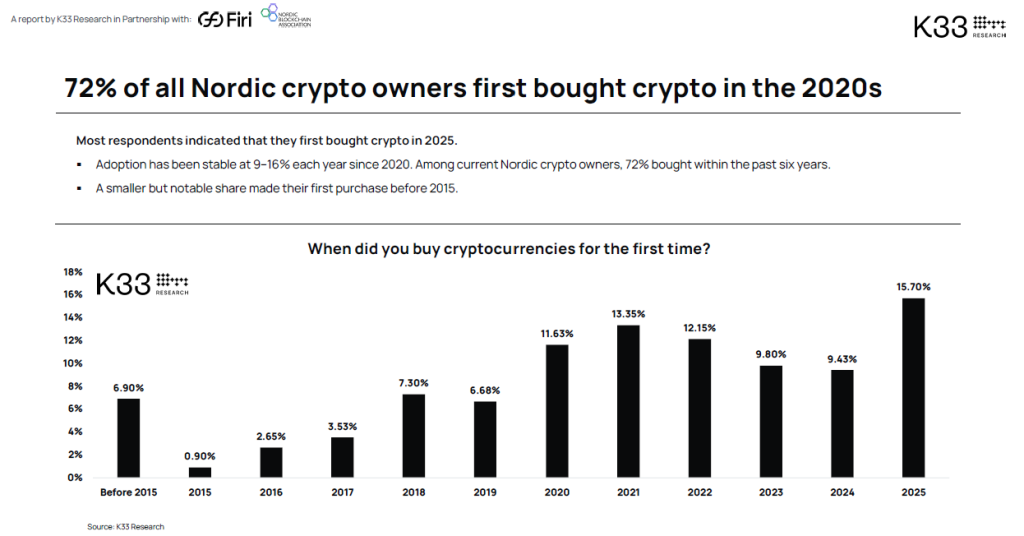
The least objectionable portion of the survey’s many detailed results is the reported year in which a user first acquired their bitcoin (or “crypto”). The curve passes the sniff test and approximately looks like a bitcoin graph, meaning that it tracks wider information exposure and access.
The takeaway from an admirable effort and a hundred-page report is unfortunately that:
There either isn’t much adoption in the Nordics, in which case this survey is a little pointless, or the survey is missing all the real Bitcoiners, whales, and those with large holdings… in which case the survey is a little pointless.
In sum, it’s not clear how much new information we can glean from this. A better approach might be to query (and sum up) unique users and activity on the various Nordic exchanges and compare that with holders of e.g, ETPs.