When madness and hubris overtook the Bitcoiners and financial markets alike in the summer of 2025, a few strange things happened.
First, shares in bitcoin treasury companies (themselves just a pot of financialized bitcoin) started trading way above the value of the coins they represented.
Second, the financial market equivalent of “the universe abhors a vacuum” rushed in, launching literally hundreds of these companies onto stock markets all over the world.
Third, in trying to differentiate and maintain their specific value niche, they all tried to raise funds, print shares, and structure convertible debts or other liabilities in order to take advantage of the generational bitcoin bull run.
Alas, we know how this story ended.
When the product you’re selling is overvalued shares, and plunging new investor proceeds from ever-larger securities issuance into ever more bitcoin, two things set an abrupt end to that glorious, orange suitcoiner party:
a) overvalued shares no longer appeal to investors, and
b) bitcoin’s price falling.
It didn’t take long before there was no more financialized equity to extract.
The leading source of bitcoin company balance sheet holdings, BitcoinTreasuries.net, still lists 13 Nordic companies owning bitcoin.
We took a closer look and provide a brief overview of the seven most astonishing stories of financial hubris:
1. H100 is the largest, most active and well-covered Nordic treasury company. Through acquisitions and changes in leadership recently, it’s been pretty good at garnering attention with its core audience and so we have a fairly good idea of what they’re up to.
Bitcointreasuries.net states it holds ₿1,051 (corroborated by its public financial reports), basically unchanged since the treasury company flywheel stopped working in September 2025. Since buying pretty aggressively during the summer (at a blended price of about $115,000), the company has carried massive bitcoin-related losses, having toyed with convertible debts and overplayed its hand.
After a few acquisitions and changes, H100 is currently trying to merge with Geir Harald Hansen’s company Moonshot (and Never Say Die AS), which should bring the total bitcoin treasure to around ₿3,500.
This is achieved via heavy share printing and, in this case, a new, majority owner. The stock is trading today roughly where it was when H100 reverse-merged into Healthy to 100 AS and began its bitcoin journey on public markets; and it’s down about 93% from its June 2025 peak.
Per the annual report, by year-end, the company had a 75mSEK convertible loan and about 30mSEK in cash, with no other lien on the bitcoin stash, so there is some financial acrobatics in the firm’s future. (For reference, its bitcoin is now worth about 600mSEK.) Of course, the accounting losses from the past year were roughly half that, which is to be expected if you aggressively buy the peak, and then ride it all the way down.
2. Fragbite is a formerly successful gaming company, listed in Stockholm and still with an ongoing operating business in online gaming, acquired its first few bitcoin at $113,000 last summer. Thereafter, it fully YOLO’d into a bitcoin strategy rather late, but still managed to hit the peak at around $120,000.
The CEO has since resigned, the company holds ₿31.25 (per its Q1, 2026 report, acquired at $114,642) and began doing bitcoin options trading a few months ago.
Curiously, the “options trading” operations involve MSTR, Strategy’s common stock, not actual bitcoin or actual bitcoin options.
(Since it’s for short-term trading and the company hasn’t reported Q2 yet, we can’t know exactly, but per March 31, its balance sheet showed “financial assets” to the tune of about 60% of its bitcoin holdings, so the trading is quite substantial.)
Interestingly, Fragbite is not printing shares to pursue its bitcoin strategy.
3. B Treasury Capital is a “pure-play” bitcoin company, proudly boasting of a “net sales: 0” post in its financial reporting. Five dudes and a pot of publicly listed bitcoin combined with some liabilities (including a BTC-backed custodian loan and a BTC-denominated convertible debt).
Refreshingly, it’s one of the few treasury companies that has regularly purchased bitcoin during the spring. It has just closed its preferred share (heavily undersubscribed) for the Swedish market. At year-end, the cost basis for its then ₿166.8 holding was, symbolically, right above the 1-million Swedish Krona (SEK) mark.
Since it was listed in July 2025, its shares are down 80%.
4. Bitcoin Holding Sweden, AB, is a mostly invisible latecomer to the treasury space, having only acquired a small amount (₿2.53) before it suddenly stopped in late November. It markets itself as “Sweden’s upcoming public Bitcoin Treasury company,” suggesting that the company has a future, but alas nothing has been heard from it or its CEO for months.
Like B Treasury Capital, it ran out of funds before the flywheel got started, having a cost basis above 1-million SEK (now worth only about half that).
5. Refine Group is an e-commerce platform that jumped on the bitcoin treasury bandwagon in July last year.
Having acquired the lordly sum of ₿7, the company threw in the towel in March this year, realizing a loss of about 25%. (The day of the announcement, the share price doubled.)
Now renamed to Vetted Assets, the company made a wall-art acquisition, has almost doubled revenue, and is trading at about 10x where it was when it launched its bitcoin treasury strategy.
6. K33 is a Norwegian-listed crypto research firm, with institutional operations and an excellent industry newsletter (“Ahead of the Curve”).
Bitcointreasuries.net states K33’s holdings to ₿168, mostly unchanged since the beginning of the strategy apart from a few acquisition transactions during the year that have increased their indirect exposure. From looking over K33’s public investor reports, this is either false or misleading. Per the company’s Q1 quarterly report, K33 holds about 95 bitcoin on its balance sheet plus some “bitcoin exposure” via shares acquired in another company (which, in turn, also only seems to have “exposure,” no real stacking or bitcoin treasury strategy involved).
The share is down 75% from its June 2025 peak, and about 40% below where it was when it launched its bitcoin treasury strategy.
7. Goobit Group is the holding company behind BTCX, Sweden’s oldest bitcoin exchange. If you’ve been around European conferences in recent years, you may have seen them driving a large, pink, BTC-branded Tesla.
Despite not lacking profitability as an exchange, BTCX still hurled itself into a “long-term Bitcoin Treasury strategy, aiming to maximize the company’s bitcoin holdings.”
Announced in early August 2025, it ran the typical dilution-as-a-service strategy of issuing shares and buying bitcoin… at the top, only to thereafter go quiet amid plenty of capital destruction.
The company ostensibly still has the same ₿10.63 it acquired that one time at around $116,000 (plus another coin a few weeks later, bringing the total to 11.7 from Sept 1, 2025). The bitcoin the company acquired last year for long-term holding has now, predictably, been merged into the general business accounts:
“in order to strengthen the liquidity. Due to this decision, these 11.35 BTC were restated and moved from intangible fixed assets to inventory.”
Its diluted shares are down 82% from its local treasury-boost peak.
Incidentally, BTCX just today received a negative result on its MiCA license from the Swedish financial regulator.
The fanfare that accompanied bitcoin treasury companies into the heart of Wall Street and became the poster child for the Paper Bitcoin Summer of 2025, hasn’t been kind to most participants.
Back then, every few days, there was another Nordic company issuing shares, buying bitcoin, launching a strategy, or engaging in convertible debt offerings.
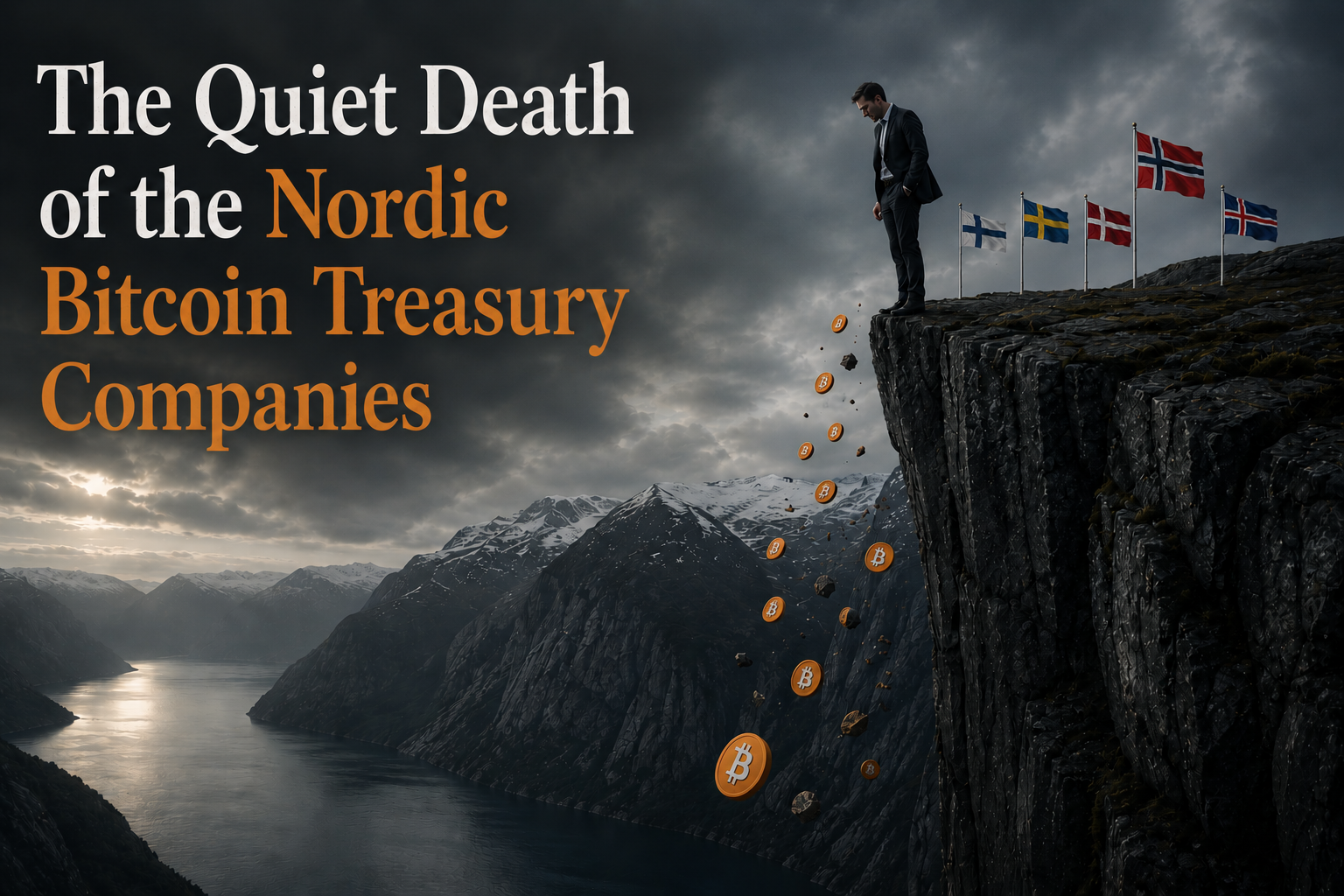
Since the flywheel stopped working in the Autumn of 2025, there have been mostly crickets from the Nordic bitcoin treasury company players. And for good reason: Almost none of the companies have been able to maintain its one-time financialization attempt, and the ones that have exited have done so rather quietly.
The bitcoin treasury scene worldwide is comatose. In the Nordics, it’s straight-up dead.