Author: Joakim

  • Deep Monetary Economics in Oslo’s Satoshi Talks

    Deep Monetary Economics in Oslo’s Satoshi Talks

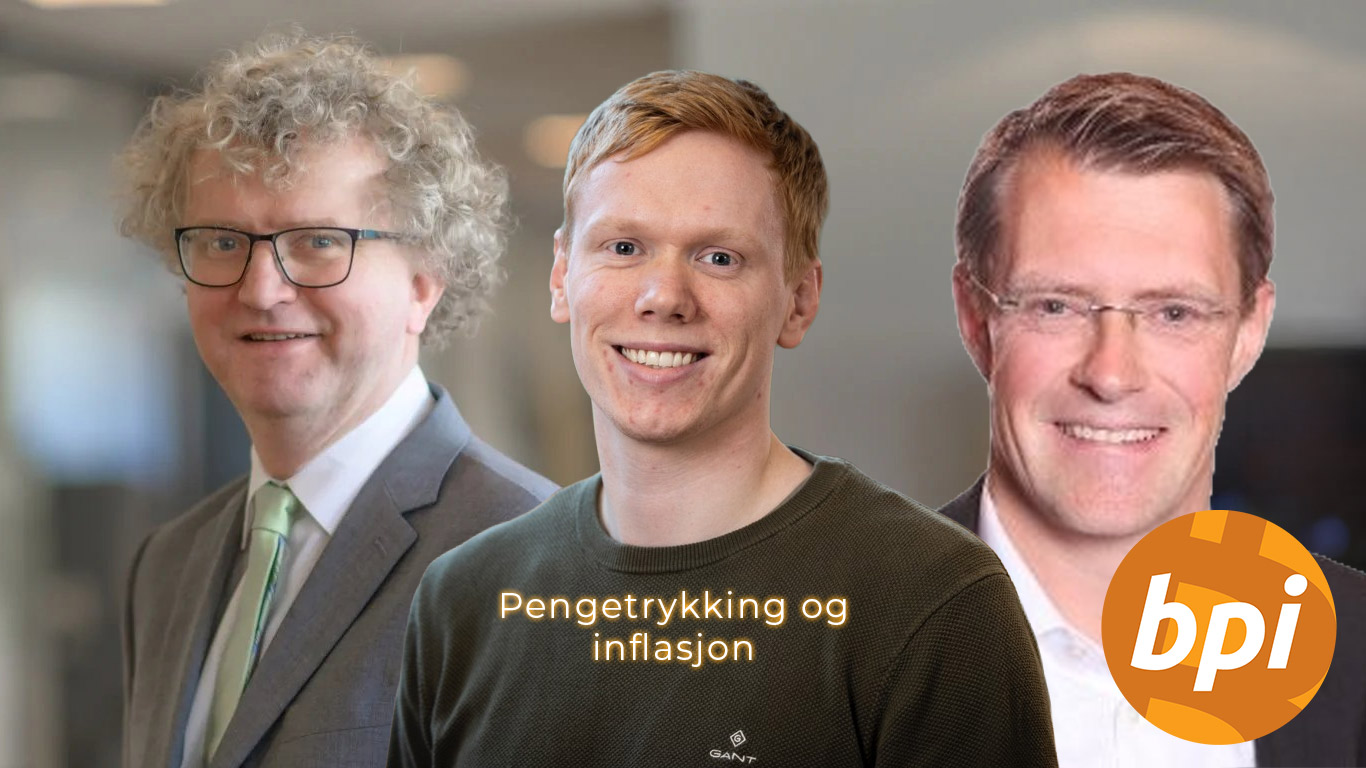
    Bitcoinpolitisk Institutt, or Bitcoin Policy Norway, organized a neat panel session at its events in Oslo’s Litteraturhuset last week. The Satoshi-samtale (“Satoshi talks”) is recorded and released as a podcast, worth listening for a deep dive into the monetary economics of Bitcoin.


    For years, BPI has put on semi-regular events in Oslo and this one doesn’t disappoint. Two guests from the banking system (Jan Ludvig Andreassen, the chief economist at Eika, and Arne Kloster, special adviser to Norges Bank) provided their views, with BPI’s Ole Emil Augland offering critical and, occasionally, quite critical, Bitcoin-oriented commentary.


    Across topics that included the intricacies of the consumer price index, how inflation works through the economy, and how it relates to money printing, the panelists meandered toward what the point and purpose of a monetary system is. At the end, Arne gave us the most succinct conflict of visions involved between bitcoin and fiat:

    “There’s a trade-off between stability and flexibility, and the monetary system we have today is very flexible but it comes with some risks, whereas a monetary system that’s closer to the old-fashioned gold standard is more stable but won’t perhaps contribute to economic growth in the same way.”


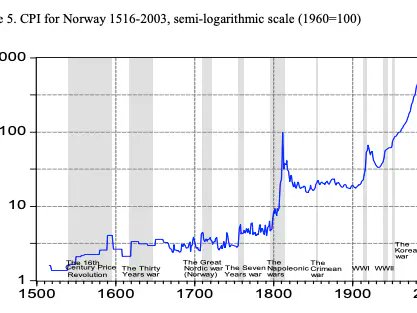
    Here’s the consumer price index graph that Arne presented, based on research and statistics from Norges Bank, and which provided backdrop to the overall conversation:

    Consumer Price Index (CPI), Norway, 1516-2003
    Norway, CPI 1516-2003, long historic time series. Source: Norges Bank.

    Briefly going through that history, Arne suggests that “inflation is, in a way, a phenomenon of war; it’s when lots of money is printed to finance soldiers’ pay, food, canons… war is expensive.”

    And what he brought to weigh on the subject was a very standard remark among the economics profession: What can be even worse than inflation is the price level change variability, “because that makes economic planning difficult.” Stable inflation is manageable since you know that the purchasing power of your money will fall by a particular, credible amount (i.e., the 2% creed), but when the change in money’s worth is unpredictable, money quickly loses its coordinating role and the monetary system turns into chaos.


    Jan Ludvig interjected that household wealth has transformed greatly in the last four decades in Norway, where real estate is concerned. It used to be mostly owned by institutions, but from around 1985 Norway experienced “a historic transfer of value from institutions to households, which also meant that changes in property prices meant so much more than they used to. But they’re not part of the money supply!” Which they probably should, Jan Ludvig suggested.  

    In a beautifully phrased remark by Ole, about the downsides of calculating a consumer price index, we learn that just because a computer improved in raw, objective power (e.g., RAM, memory, speed), statisticians make an error in assuming that the economic value of the item has increased in proportion.

    “They can’t say that ‘yes, the price should be 12,000 instead of 11,000 […] they’re trying to calculate objectively something that is subjective, that is value.”


    You can learn more about Bitcoin Policy Norway (“Bitcoinpolitisk Institutt Norge”) and their work via BPINorge.no.

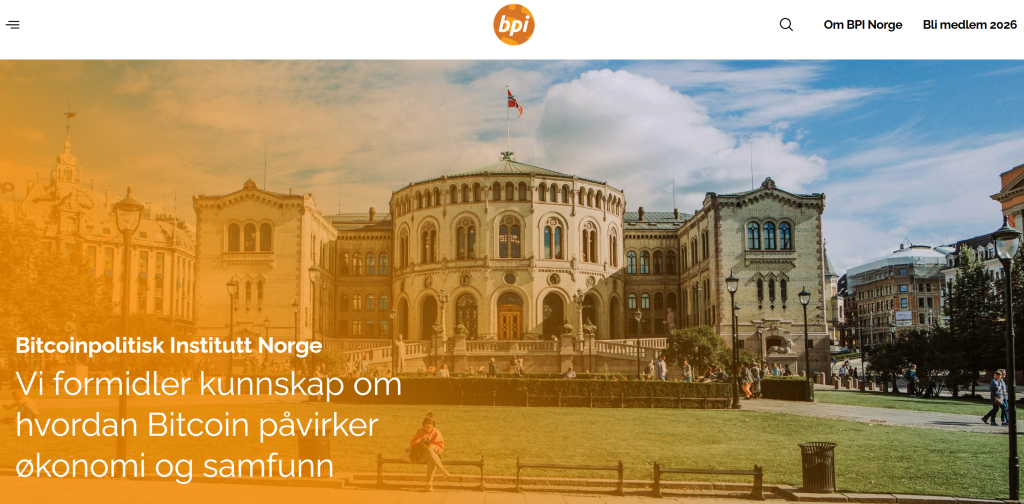
    Norway's Parliament, Stortinget, overlaid with Bitcoinpolitisk Institutt Norge's frontpage and slogan: Vi formidler kunnskap om hvordan Bitcoin påvirker økonomi og samfunn
    A view of Norway’s parliament, Stortinget, as seen on Bitcoin Policy Norway’s front page.
  • Defending Bitcoin: An Exclusive Interview with Luke de Wolf

    Defending Bitcoin: An Exclusive Interview with Luke de Wolf

    And so the time has come. Let the Nordic authoring dominance proceed!

    For months, Luke de Wolf, co-founder and head of programming for BTCHEL, labored over precisely how his view of Bitcoin security was different.

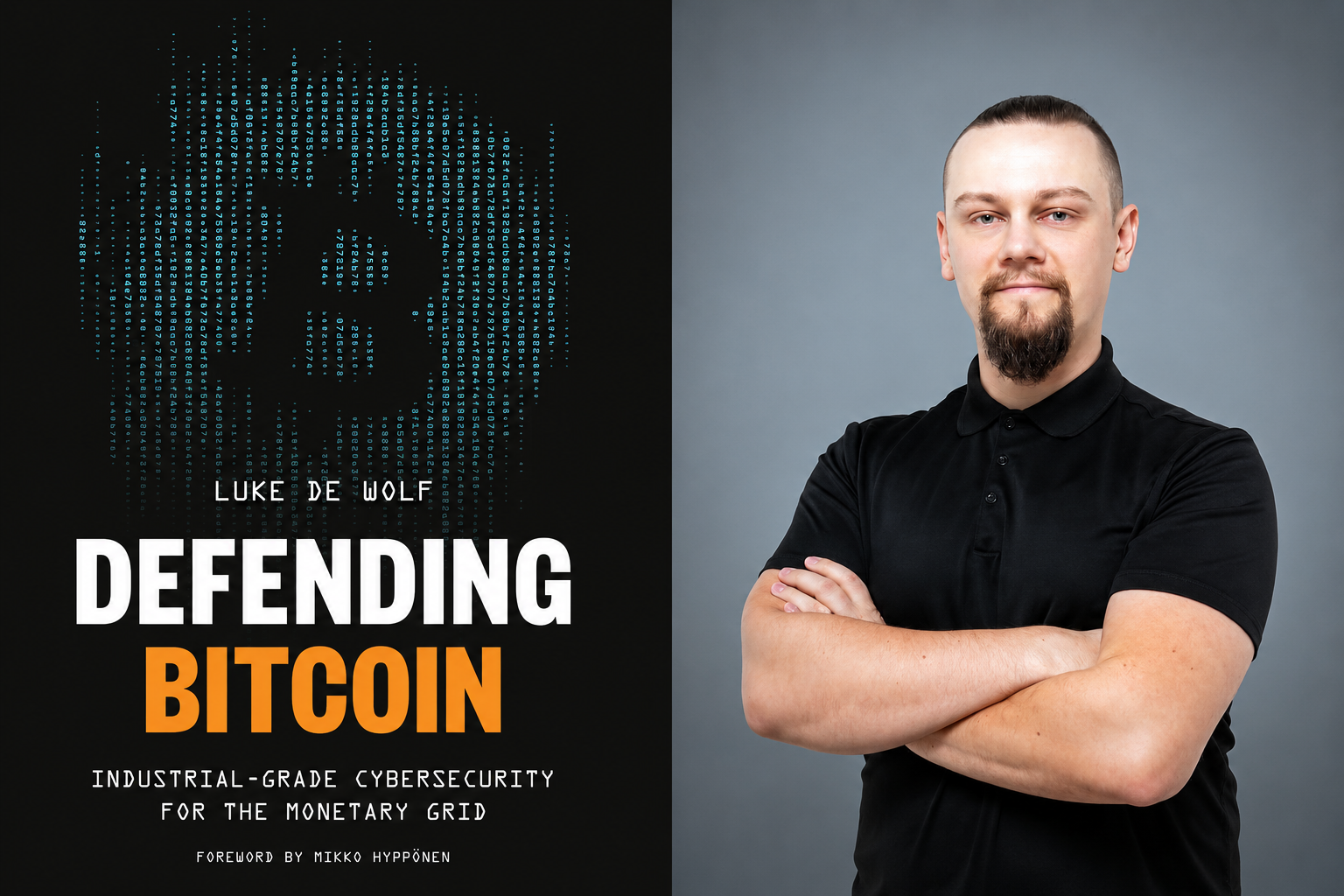
    And next week, June 15, the book is out. Defending Bitcoin: Industrial-Grade Cybersecurity for the Monetary Grid is bound to be one of the most noteworthy Bitcoin books of the year.  


    It’s a serious, deeply considered security investigation of Bitcoin. Coming from an industrial control system point of view, Luke lays out a framework for thinking about threats and then spends ten ridiculously well-researched and balanced chapters investigating everything from quantum to arbitrary data, mining centralization, key management and physical security.

    I caught up with Luke and asked him a bunch of questions I hoped nobody had asked him before. Here’s a lightly edited transcript of our interview.


    JB: What was the most surprising thing you learned or discovered during the process of writing and researching the book?

    LW: I really had to get up to speed with a lot of low-level technical aspects of Bitcoin.

    I went back and reread Mastering Bitcoin [by Andreas Antonopoulos], but that was a bit hard to follow. I then read Grokking Bitcoin and Bitcoin Development Philosophy by Kalle Rosenbaum. (Those would be my top picks for someone to understand the technical side of Bitcoin, although Grokking could use an update to reflect the latest protocol changes…)


    I even took the Saving Satoshi challenge put on by Chaincode, which forced me to dust off my programming skills and do real Python coding. I learned a lot through the process, and I made it all the way to the end, with the invite to the BOSS challenge as my reward. Time commitments, not the least of which being this book, prevented me from taking the process further, but the experience was interesting and enlightening.

    I would say that the area I learned the most was in Bitcoin Script, where I had a rough understanding from Twitter discourse but hadn’t really gotten my hands dirty before.


    “After writing the book, I feel confident that I understand the whole area a lot more, and I can speak more confidently about controversial scripting changes.”

    JB: How did the idea for the book come to you? I wanna recall JK Rowling describing how the story of Harry Potter just suddenly flooded her mind, fully formed and all at once. Did you have a similar revelation with Defending Bitcoin, or was, perhaps, the constant arguing with people on Twitter last year involved in coaching it out of you?

    LW: This was an “aha” moment. I had been arguing about BIP-110 with a few prominent people, but one conversation with Stephan Livera specifically sparked the whole idea for Defending Bitcoin. I realized that I had been advocating against arbitrary data because of the same principles that govern critical infrastructure security, and everything basically fell into place. I knew exactly what kind of book I wanted to write, immediately.


    I knew I would need to build a base of vocabulary and introduce both Bitcoin and cybersecurity, and from there talk about the threats to Bitcoin and the ways to defend against those threats. I reordered two chapters and changed the contents of one after building the initial outline. That was two weeks after the initial idea.


    JB: What have you changed your mind about in writing the book?


    LW: I changed my mind about BIP-110.

    Not about the content of the change: I remain adamant that BIP-110 would be a positive thing for Bitcoin. I assert throughout Defending Bitcoin that the tradeoff to security is convenience, or, put more plainly, that every decision has tradeoffs.

    I find the technical restrictions demanded by BIP-110 to be extremely reasonable. Developers have to operate within a slightly more restrictive environment, temporarily. I don’t find that outcome to be unacceptable.

    My opposition came through writing the chapter on Governance issues, which you might think, initially, would just entrench my view that something is rotten in Bitcoin Core, and something needs to be done at all costs. It’s the last part that I realized I don’t agree with.


    “The chaos of a fork scenario is something we can’t predict.”

    I wrote a book about risk management. I realized that I couldn’t simultaneously advocate for risk reduction in every other area of Bitcoin and advocate for a fork that doesn’t have overwhelming node consensus. I had to be honest with myself and give up a position that I had been holding for months. But, I think, if you read the book you’ll see why I came to the conclusion I did.

    That’s not to say that I wouldn’t be happy if BIP-110 were to activate. Currently, I just don’t see it activating smoothly. Without node consensus, miners effectively get to choose the outcome, and I don’t see a path to sufficient hashrate for the fork. Again, the node consensus is the issue.

    If 90%+ of nodes supported BIP-110, it would be hard for miners to justify not signaling for the fork. As it stands, the numbers are quite a bit lower. It’s not about the merits of BIP-110. I just think they’re fighting a losing battle, and, from a risk reduction perspective, I can’t support it.


    JB: Do you have a favorite phrase or sentence from the book?


    LW: There’s always something you can do.


    It was important for me to emphasize that everything relating to security comes down to individual choices. No matter the area of Bitcoin we’re talking about, there’s always something one person can do. I repeat that line like a mantra. I hope it’s what every reader remembers.


    JB: What was the writing process like? A little here or there amid life, or chapters written in long, intensive writing sessions?

    LW: I had the outline extremely early on. Apart from some minor refinements, this book existed in my head six months ago. The process was all about going from outline to first draft, then polishing the drafts, iteratively. My notes folder has 10 revision cycles, and each one I focused on different areas, including making everything more consistent.

    Full disclosure: I used AI to keep me organized. I would ask it to check if I was describing some concept inconsistently, or to make sure that each chapter included the same sorts of structural elements. Even though I planned these things out myself, inconsistencies crept in. It was also an invaluable fact checker, keeping me honest whenever I made claims that wouldn’t hold up under scrutiny. I never used AI to actually do any writing. It was all me. But I probably would either have produced a less coherent book or done it more slowly without AI assistance.

    In any case, this consumed my life for six months. I obsessed over it, and worked hard to make sure every detail was correct. I’m proud of the end result.


    Through going on podcasts and discussing Defending Bitcoin with others, I realize that maybe I could have emphasized a certain point better, or that I missed something I really should include later. But I’m confident that the book, as it is, gives anyone who reads it the tools to be more confident about Bitcoin security, and about the outlook for Bitcoin in general.


    Defending Bitcoin: Industrial-Grade Cybersecurity for the Monetary Grid is out June 15, and you can find early copies at BTC Prague this week.

  • That Nordic Bitcoin Adoption Survey from K33

    That Nordic Bitcoin Adoption Survey from K33

    The Norwegian-listed financial service company K33, focused on serving institutional clients in the Scandinavian crypto world, recently released its annual Nordic Crypto Adoption Survey. The company’s research arm, K33 Research, has released these types of survey-based inquiries into Nordic crypto usage and adoption for a few years now and, as always, they seem very hopeful and optimistic about the Nordic region.

    K33 itself mostly made news waves in the Bitcoin world last year with its somewhat unsuccessful participation in the Paper Bitcoin Summer craze. With some mid-100s BTC on its balance sheet (bitcointreasuries.net says 141, the company’s Q1 investor report, released yesterday, states 168 of BTC “exposure”), mostly acquired in July last year, the company stopped acquiring more coins as BTC/USD prices turned down and the mNAV arbitrage playbook stopped working.


    That is, its financialization effort didn’t pan out, and now the company is pivoting to other market lines, including collateralized loans.

    The report itself, authored by K33’s Head of Research Vetle Lunde, is fairly comprehensive, or at least as well done as can be expected for information-gathering efforts such as these. The 130-page report is filled with graphs and numbers covering crypto users in Finland, Sweden, Denmark, and Norway (plus a public presentation on Iceland, which it covered for the first time this year).

    Surveys, generally speaking, have well-known scientific and statistical problems, particularly in noisy environments where people aren’t exactly eager to answer them. The problem gets orders of magnitude worse in the Bitcoin (and broader crypto) space where privacy is cherished and there’s no upside to confessing and advertising one’s holdings.

    To be polite about it, what the survey finds is not at all representative of the population it is trying to describe.

    Having said that, here are some of the juicier headline results:

    • “2.5 million people in the Nordics own cryptocurrency, equating to 11.1% of the adult population.”
    • “A meaningful share of the Nordic population has owned crypto in the past but no longer does. 6.8% of Norwegians, 7.4% of Swedes, 7.3% of Danes, and 9.2% of Finns report having exited the market.”
    • “More young Nordics now own crypto than directly own stocks, with roughly 1.53 million crypto owners compared to 0.94 million equity owners in comparable age groups.”


    Astonishing Progress for Bitcoin in the Nordics

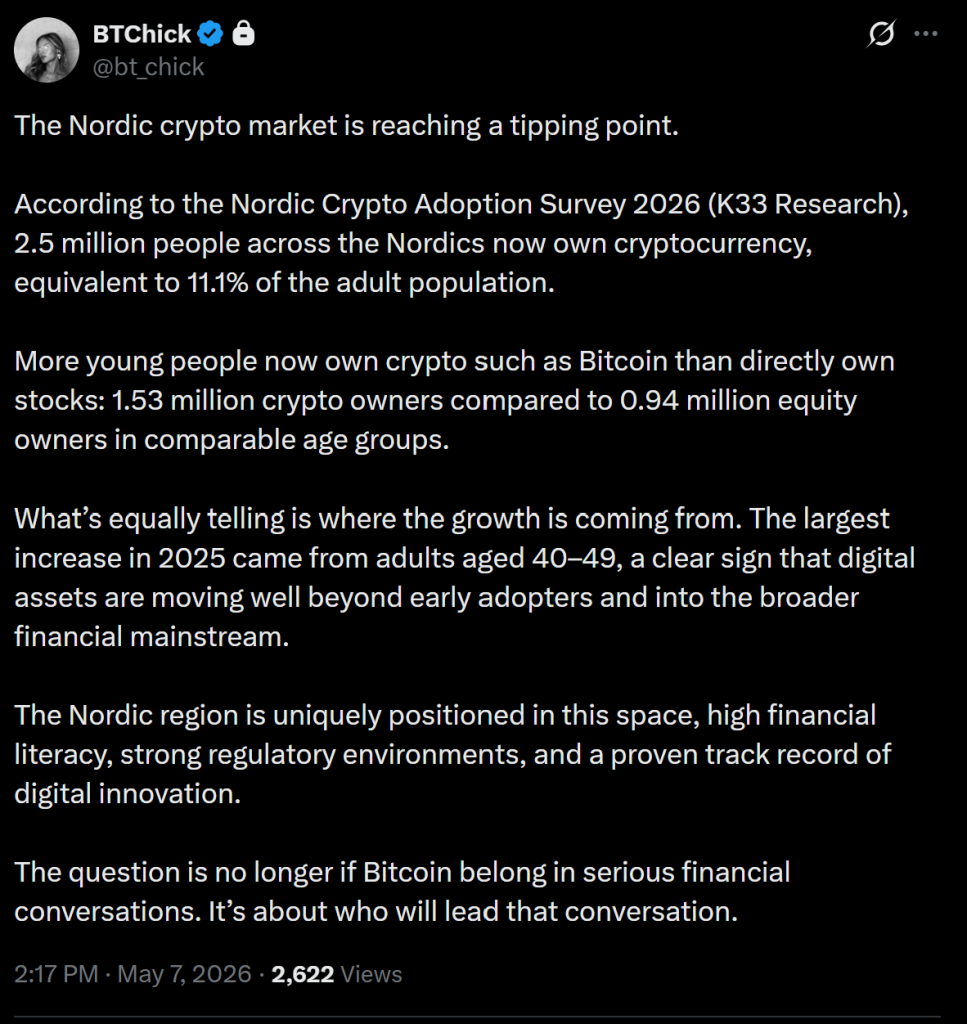
    At a glance, these results look incredible. Here’s BTChick, a Swedish bitcoin influencer, around the time of the report’s release:

    BTChick remarks on Twitter.


    There’s no doubt that there’s some sort of gradual acceptance accompanied by increased adoption and financial flows. Spotted around Stockholm and in public transport in recent weeks are ads by Bitwise, a leading exchange-traded products provider that listed several funds on Nasdaq Stockholm this year, offering crypto exposure “without hassle.” In a talk at the Swedish Bitcoin Symposium 2026, Marco Poblete, Bitwise’s Nordic regional director, presented on the company’s goal of turning “Bitcoin haters into Bitcoin lovers.


    What the K33 Research reports have going for them is the consistent approach and long-term scope (relative to this industry, anyway). For whatever methodological flaws and faults it contains, comparison across years is pretty neat.; quite a lot of those figures go up and to the right.

    How much of that is capturing a real trajectory rather than statistical noise or a normalization of a new asset class is hard to tell.

    Besides, much murkiness hides behind these impressive headline claims. For example, to engineer the conclusion that “more” young Nordics own crypto than stocks, K33 Research had to explicitly exclude funds and pensions… only the most common and widely owned financial products in e.g., Sweden.

    “We compare self-reported crypto ownership with register-based holdings of listed shares. Figures exclude funds, pensions and some brokerage structures.”


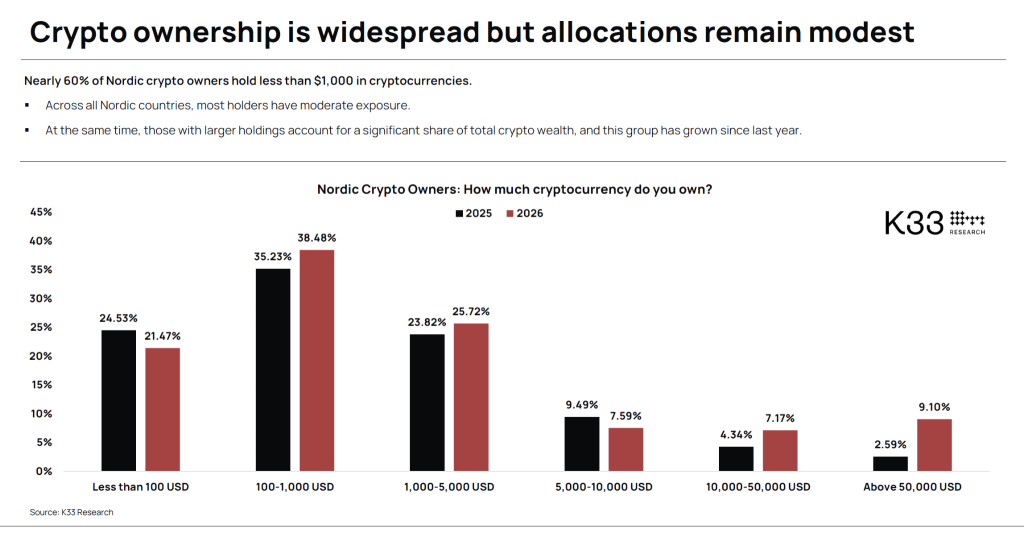
    The 2.5-million figure, or 11% of the Nordic population, is literally unbelievable. Surveying the reported distribution of holdings makes clear how they arrived at that number: Most are trivial (“modest”) holders.

    Nordic Crypto Ownership, per K33 Research’s Nordic Adoption Survey 2026.

    Most of the survey respondents who indicate positive holdings (some 386 people…), report trivial holdings (below 6 million sats). This looks much more like a side-hustle gambling on shitcoins, or some premine allocation, an airdrop receipt, or an online influencer promotion payment than it does consistent, regular stacking by a devoted set of young people embracing a new asset class. And as remarked on above, on the right tail of the distribution, you’re bound to miss a lot of the larger holdings (the “missing-rich” undercoverage problem).

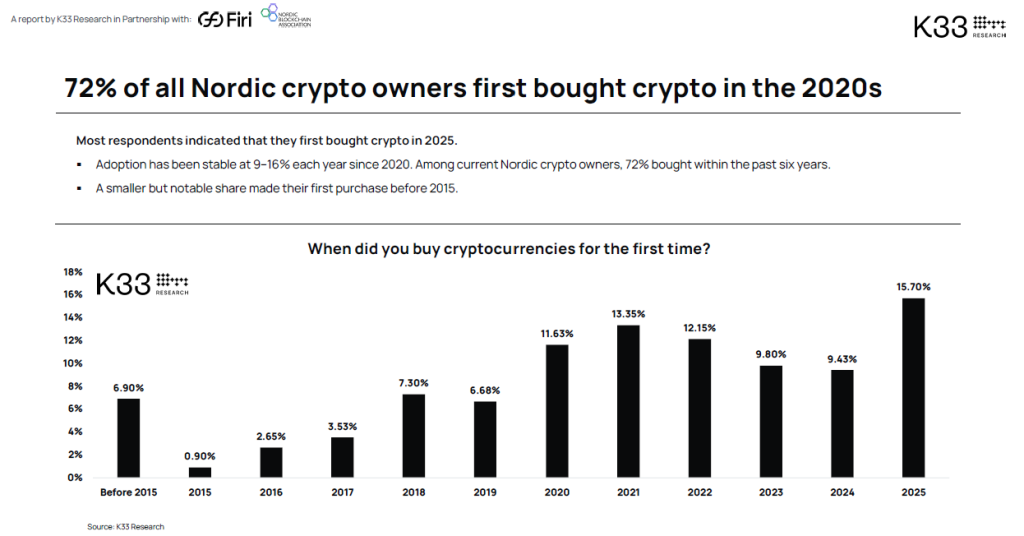
    The least objectionable portion of the survey’s many detailed results is the reported year in which a user first acquired their bitcoin (or “crypto”). The curve passes the sniff test and approximately looks like a bitcoin graph, meaning that it tracks wider information exposure and access.

    When Nordic crypto owners ostensibly acquired their first coins.


    The takeaway from an admirable effort and a hundred-page report is unfortunately that:

    There either isn’t much adoption in the Nordics, in which case this survey is a little pointless, or the survey is missing all the real Bitcoiners, whales, and those with large holdings… in which case the survey is a little pointless.


    In sum, it’s not clear how much new information we can glean from this. A better approach might be to query (and sum up) unique users and activity on the various Nordic exchanges and compare that with holders of e.g, ETPs.


    Some thoughts for next year.

  • Welcome to the Nordic Node, a Newsletter from BTCHEL

    Welcome to the Nordic Node, a Newsletter from BTCHEL

    Your No. 1 Place for What’s Bitcoining in the Nordics!

    We are rolling out our biweekly newsletter, specifically focusing on the Nordics! BTCHEL is already the biggest Bitcoin conference in the Nordic countries, and as an effort to dominate the media landscape (and educate our fellow northern brethren in the orange art), we’re launching a media empire. Goal? “Become the most impactful Bitcoin media in the Nordics.”

    “We’re already the most impactful Bitcoin event in our region. Now we’re increasing our focus on digital media, too, in order to deliver the best possible physical events for our attendees.”


    Remu dropped the full story the other week, together with what else is cooking in Helsinki:

    Every other week, the Nordic Node collects the best, snarkiest, most interesting Bitcoin news from our Nordic latitudes — from the 54.35°N of southernmost Denmark to the far, frigid realms of Rossøya, Svalbard (80.50°N). We cover all things Bitcoin across Sweden, Denmark, Norway, Iceland, and, of course, Finland, home to our great benefactor and the largest Bitcoin conference across these lands. (Some have said it might even be the best Bitcoin event out there…)

    For today’s inaugural newsletter, we have two stories of quirky bitcoin coverage in tradfi Scandinavian media: First, Dagens Nyheter, Sweden’s largest newspaper, telling its readers that the spending vouchers given out at Litteraturmässan, “litcoins,” were not at all like bitcoin!

    Second, Denmark’s central bank is shocked to learn that no more than 4% of Danes confess to owning “crypto-assets.”


    Sign up for the Nordic Node here and follow along our journey!

    Seen any Nordic-relevant Bitcoin news you think we should cover? You can reach me at joakim@btchel.com.