Category: Adoption

  • Ioni Appelberg and Abundance Through Scarcity: Civilization and Space

    Ioni Appelberg and Abundance Through Scarcity: Civilization and Space

    The first time I read Ioni Appelberg’s great Abundance Through Scarcity was in a D.C. hotel restaurant at the height of the last bull market. It felt celebratory and appropriately lifted my gaze from the depravity of that lost, despicable, politicized city. Money is civilization; civilization is energy; energy propels us forward, technically, and outward, spatially. Our destiny is to become a space-faring nation — or to perish.


    Because I’m different, the times are different, and Ioni actually updated and revamped the book this year (meaning the book itself is different), it’s hard to tell exactly why reading Abundance this time around is an altogether different experience.

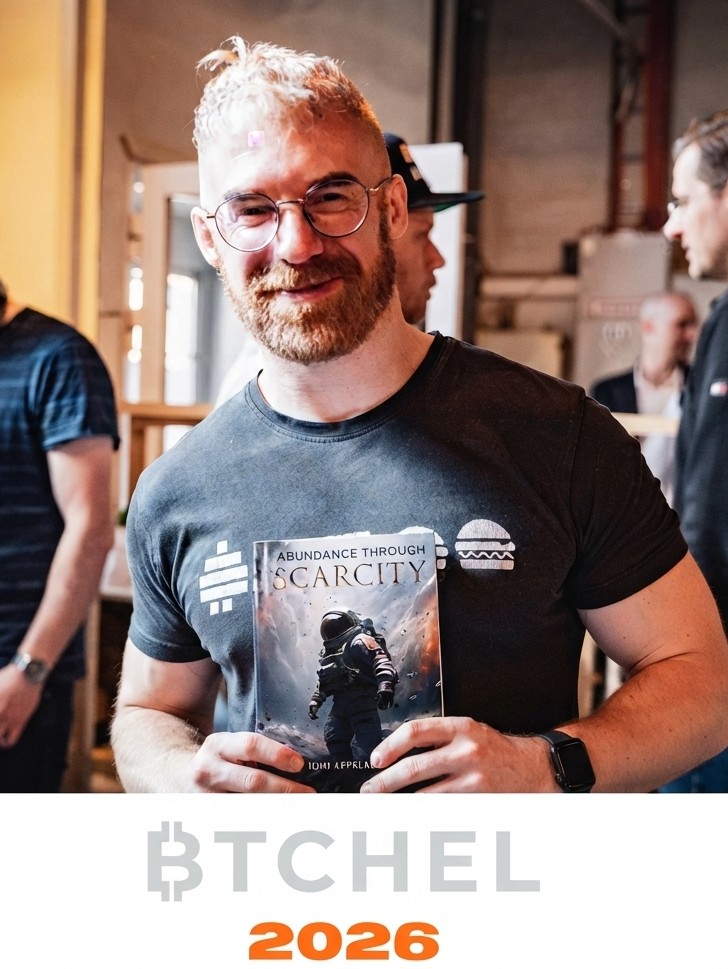
    It still has the same lift-your-goddamn-gaze flavor. It’s still obsessed with space and human civilization — quite often the Roman one. It still celebrates money as this insane, improbable, incredible cooperative device between humans. It’s the silent patchwork/bind knitting us together as a species, as a civilization, as the economic collaboration that is the world economy. That the cover is a Bitcoin-clad Astronaut battling a space storm on some far-off planet is strange and unconventional, until you realize that Ioni is obsessed with humans — as a global civilization — becoming a space-faring species.


    But fiat, and its increasingly broken and collapsing institutions, were not meant for the space age. “Fiat currency evolved for a different world,” (p. 227) i.e., our national (often centrally directed) economies, where coordination horizons remain short. For bigger, solar-system endeavors, we need something else:

    “Trying to run a planetary civilization on institution-bound money is like trying to stream video over a fax machine. The infrastructure is not built for what we are trying to do.” (p. 227).


    Then again, Bitcoin with its ten-minute block times would struggle as intergalactic or even galactic money: It’s too slow, the light years of distance between planets and solar systems in our galaxy too vast. Mars, let alone the moon, will probably resort to their own chains.


    The Most Important Thing Satoshi Gave Us


    Scarcity. True, unfakeable, unrivalled scarcity: “scarcity that does not depend on geology or engineering. Mathematical scarcity” (p. 103). Up until Satoshi unleashed Bitcoin on the world, everything digital was infinitely copiable. Nothing (but immediately accessible, material things) was truly ownable. The white paper’s great disruption was

    “…a side effect of making one thing abundant that had previously been scarce: the ability to move value without permission” (p. 150).


    What I saw this time reading the revamped Abundance was an urgency I didn’t notice last time. We are running out of time.


    The rhetorical twists he uses hit like gut punches. Voyager, the hopeful satellites we (“we”) sent out at the peak of the space race, were filled with human language, whale songs, art, and some small collection of the best of what we are. Sent out for an unknown future and improbable meeting, it “keeps going, unchanged, because it was built at a moment when civilization still believed in tomorrow….

    We are the ones who stopped.”


    Abundance is mostly a hopeful book, the way Ioni strikes me as a hopeful, kind soul. It asks the reader to lift their gaze and consider human life and existence on a larger scale, on a longer time frame, doing something more important than your everyday life. And if it hits right, it asks the reader to work diligently for civilization’s success and thriving instead of its decline.  

    It’s also a doomerist, terrifying story — reminding us that what we’re doing here in Bitcoinland is much more important than number-go-up or preserving wealth from the value erosion that is money printing and inflation.


    Bitcoin is here and works, but the wider public remains mostly ignorant of it — if not outright hostile. This is the sort of goldbug/black-pilled/Austrian doomerism I can get behind… fiat can, if not thrive and flourish, muddle through much longer than anyone thinks reasonable.


    This has to work soon, or else (Western) civ is quite rapidly circling the drains.


    Abundance through scarcity sounds like a contradiction — until you realize that some (most?) of the greatest things humanity ever achieved happened by taking away rather than adding; adding by subtraction. Via Negativa. Or, in the overarching metaphor of the book itself: Michelangelo saw — so goes the apocryphal story, anyway — his masterpiece marble sculpture “David” in a piece of inferior block, rejected by everyone else as unsuitable for crafting anything. Just take away everything that isn’t David.


    Toward the very end of the book, Ioni speculates once more on the great filtering and the Fermi paradox (which I was told recently by someone working for NASA, was haphazardly written on a napkin and should be considered accordingly) that “Perhaps the Great Silence is filled with worlds that mastered energy, computation, and intelligence, yet never learned how to endure” (p. 245).

    “The record persists, waiting to see whether it will become the backbone of a conversation across thousands of generations, or a root or in the ruins of another failed ascent” (p. 246).


    This week, you’ll find Ioni giving a lecture on Bitcoin and longevity on Friday exclusively for the OG stage, and be part of the main stage panel session on “Sauna, Meat, and Sun: Bitcoin meets Biohackers” on Saturday.


  • Eric Yakes: BTCHEL Is a “Good Vibes” Conference

    Eric Yakes: BTCHEL Is a “Good Vibes” Conference

    An age ago in Bitcoin years (early 2021), Eric Yakes released The 7th Property: Bitcoin and the Monetary Revolution. It was among the first great “Bitcoin-money” books, a standardized genre where authors thoughtfully consider the role of money in society and history, assess its qualities and characteristics, and only brings in bitcoin and its technobabbling details about halfway through.

    “it wasn’t until I wrote a Bitcoin book that I realized there were so many Bitcoin books out there.”


    Over the years, we’ve been inundated with books like that. Some of great quality, like Lyn Alden’s Broken Money that I — full disclosure — edited, and others of regular trash status.

    The writing-publishing endeavor has, as far as I can tell, cooled down a bit, with the audience more than saturated. To publish successful Bitcoin books a cycle-plus after Yakes, you gotta go big macro (Larry Lepard’s The Big Print), big beginner (Natalie Brunell’s Bitcoin is for Everyone) or very specialized (Leon Wankum’s Digital Real Estate or Aaron van Wirdum’s The Genesis Book — both of which I also worked on).

    The book is almost six years old now, so I wondered what Eric would have done differently today. “There’s a million things I’ve learned since writing the book,” Eric says. His major point with The 7th Property was to give a synopsis of money, banking, and bitcoin from an investor standpoint — the latter being the key demographic.

    “The book did much better than I would have expected at the time.” He described how some books are too heavy on opinion and commentary, and others too lengthy and heavy on the raw, dry facts. You have to strike a balance between expertise and editorializing. “I wanted this to be something that is engaging.”

    He received a lot of mixed feedback: some people thought The 7th Property had “a clear understanding of the problem” and dealt with money and banking in a comprehensive way; others that it was too technical of a book, or too summary. Also, “there was a lot of dentists reaching out… that surprised me.”


    I read a quote to him from the book — “For Bitcoin to compete with the incumbent system, the incumbent’s financial services will need to be replicated in bitcoin” (p. 263) — and wondered if, given the Paper Bitcoin Summer and the last year’s treasury company wave, he stands by that line.


    “I 100% still think that statement is true. Bitcoin is something where the value proposition increases with the amount of capital that enters the system.” By way of a tree analogy, Eric tells me that Bitcoin, like trees searching for sunlight, “is growing toward where the capital is, toward financial markets and the stock market specifically.”


    “The larger bitcoin becomes, the more it can stand on its own.” But until then, building bridges to and integrating with where the capital exists today is how way we make Bitcoin bigger. A lot of people in Bitcoinland have an idealized, black-and-white view of how adoption should proceed. “I don’t think it works like that… we don’t get to choose how adoption happens. That idealized path, it doesn’t exist.”


    One thing that hit me on re-reading the book now, a cycle-and-a-half later, is the emphasis throughout monetary history on trading off trust for efficiency. The book gives two seemingly contradictory positions on the matter:

    • “Digital money will reach an inflection point at which people will need to decide if they will trade trust for efficiency once again. It is my goal to convince enough people that they should not.” (p. 57)
    • “some people do not want to spend the time to be their own custodians, and that is perfectly reasonable but potentially costly” (p. 261)

    “This is where my thinking has developed the most on since writing the book.”


    He clarifies that he thinks that this trade-off warning is mostly intended for fiat. As we’re talking, the Liquid hack/heist has just happened, the Coldcard debacle fresh on everyone’s mind, Lightning service providers getting hacked left, right, and centre. When I mention these token wars, and he says that within Bitcoin, he’s softened his stance there a little: “we’re going through growing pains in software. As long as the tools that create security can be used for attack, we’ll reach a system of far more robust software. We’re going through growing pains… in the long run, I’m not so concerned by it.”

    “This is one way in which owning physical gold at home is safer than owning bitcoin (at least until someone shows up at your house and robs you).” He admits that he hasn’t seen any victory laps from the goldbugs on this either, which is sort of surprising.

    At the end of our talk, I ask about Helsinki and BTCHEL, as Eric will give a keynote on the first day and also spoke at the event last year. He says he’s looking forward to heading out to Finland and that “BTCHEL is a good vibes conference.”

    What he loved about last year was that there “seemed to be a lot of new people,” an audience that’s very different from the usual crowd that attends conferences. The BTCHEL team is working at the marginal forefront of Bitcoin, expanding the circle, reaching new audiences.


    Good vibes indeed. See you all next week!


    BTCHEL2026 CTA tickets, 25-26 September
  • That Nordic Bitcoin Adoption Survey from K33

    That Nordic Bitcoin Adoption Survey from K33

    The Norwegian-listed financial service company K33, focused on serving institutional clients in the Scandinavian crypto world, recently released its annual Nordic Crypto Adoption Survey. The company’s research arm, K33 Research, has released these types of survey-based inquiries into Nordic crypto usage and adoption for a few years now and, as always, they seem very hopeful and optimistic about the Nordic region.

    K33 itself mostly made news waves in the Bitcoin world last year with its somewhat unsuccessful participation in the Paper Bitcoin Summer craze. With some mid-100s BTC on its balance sheet (bitcointreasuries.net says 141, the company’s Q1 investor report, released yesterday, states 168 of BTC “exposure”), mostly acquired in July last year, the company stopped acquiring more coins as BTC/USD prices turned down and the mNAV arbitrage playbook stopped working.


    That is, its financialization effort didn’t pan out, and now the company is pivoting to other market lines, including collateralized loans.

    The report itself, authored by K33’s Head of Research Vetle Lunde, is fairly comprehensive, or at least as well done as can be expected for information-gathering efforts such as these. The 130-page report is filled with graphs and numbers covering crypto users in Finland, Sweden, Denmark, and Norway (plus a public presentation on Iceland, which it covered for the first time this year).

    Surveys, generally speaking, have well-known scientific and statistical problems, particularly in noisy environments where people aren’t exactly eager to answer them. The problem gets orders of magnitude worse in the Bitcoin (and broader crypto) space where privacy is cherished and there’s no upside to confessing and advertising one’s holdings.

    To be polite about it, what the survey finds is not at all representative of the population it is trying to describe.

    Having said that, here are some of the juicier headline results:

    • “2.5 million people in the Nordics own cryptocurrency, equating to 11.1% of the adult population.”
    • “A meaningful share of the Nordic population has owned crypto in the past but no longer does. 6.8% of Norwegians, 7.4% of Swedes, 7.3% of Danes, and 9.2% of Finns report having exited the market.”
    • “More young Nordics now own crypto than directly own stocks, with roughly 1.53 million crypto owners compared to 0.94 million equity owners in comparable age groups.”


    Astonishing Progress for Bitcoin in the Nordics

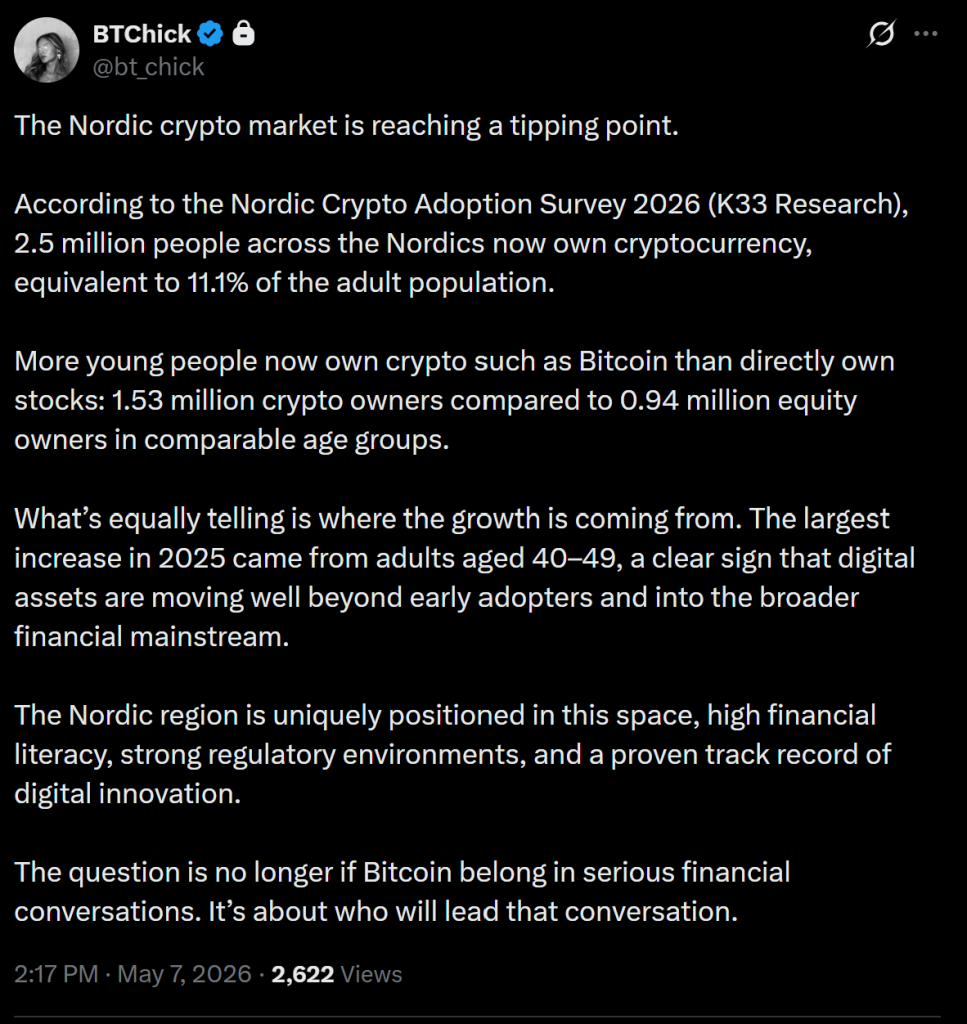
    At a glance, these results look incredible. Here’s BTChick, a Swedish bitcoin influencer, around the time of the report’s release:

    BTChick remarks on Twitter.


    There’s no doubt that there’s some sort of gradual acceptance accompanied by increased adoption and financial flows. Spotted around Stockholm and in public transport in recent weeks are ads by Bitwise, a leading exchange-traded products provider that listed several funds on Nasdaq Stockholm this year, offering crypto exposure “without hassle.” In a talk at the Swedish Bitcoin Symposium 2026, Marco Poblete, Bitwise’s Nordic regional director, presented on the company’s goal of turning “Bitcoin haters into Bitcoin lovers.”


    What the K33 Research reports have going for them is the consistent approach and long-term scope (relative to this industry, anyway). For whatever methodological flaws and faults it contains, comparison across years is pretty neat.; quite a lot of those figures go up and to the right.

    How much of that is capturing a real trajectory rather than statistical noise or a normalization of a new asset class is hard to tell.

    Besides, much murkiness hides behind these impressive headline claims. For example, to engineer the conclusion that “more” young Nordics own crypto than stocks, K33 Research had to explicitly exclude funds and pensions… only the most common and widely owned financial products in e.g., Sweden.

    “We compare self-reported crypto ownership with register-based holdings of listed shares. Figures exclude funds, pensions and some brokerage structures.”


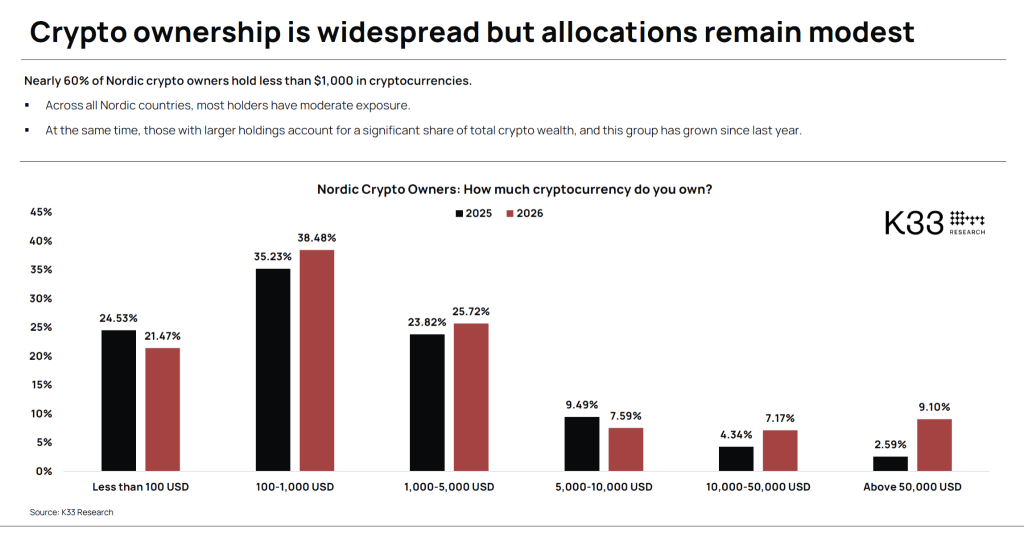
    The 2.5-million figure, or 11% of the Nordic population, is literally unbelievable. Surveying the reported distribution of holdings makes clear how they arrived at that number: Most are trivial (“modest”) holders.

    Nordic Crypto Ownership, per K33 Research’s Nordic Adoption Survey 2026.

    Most of the survey respondents who indicate positive holdings (some 386 people…), report trivial holdings (below 6 million sats). This looks much more like a side-hustle gambling on shitcoins, or some premine allocation, an airdrop receipt, or an online influencer promotion payment than it does consistent, regular stacking by a devoted set of young people embracing a new asset class. And as remarked on above, on the right tail of the distribution, you’re bound to miss a lot of the larger holdings (the “missing-rich” undercoverage problem).

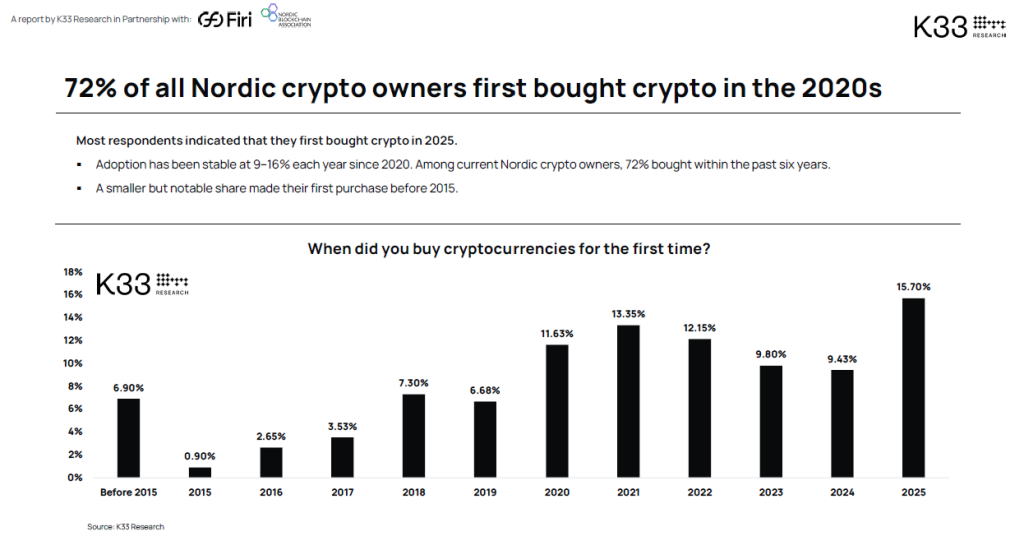
    The least objectionable portion of the survey’s many detailed results is the reported year in which a user first acquired their bitcoin (or “crypto”). The curve passes the sniff test and approximately looks like a bitcoin graph, meaning that it tracks wider information exposure and access.

    When Nordic crypto owners ostensibly acquired their first coins.


    The takeaway from an admirable effort and a hundred-page report is unfortunately that:

    There either isn’t much adoption in the Nordics, in which case this survey is a little pointless, or the survey is missing all the real Bitcoiners, whales, and those with large holdings… in which case the survey is a little pointless.


    In sum, it’s not clear how much new information we can glean from this. A better approach might be to query (and sum up) unique users and activity on the various Nordic exchanges and compare that with holders of e.g, ETPs.


    Some thoughts for next year.