
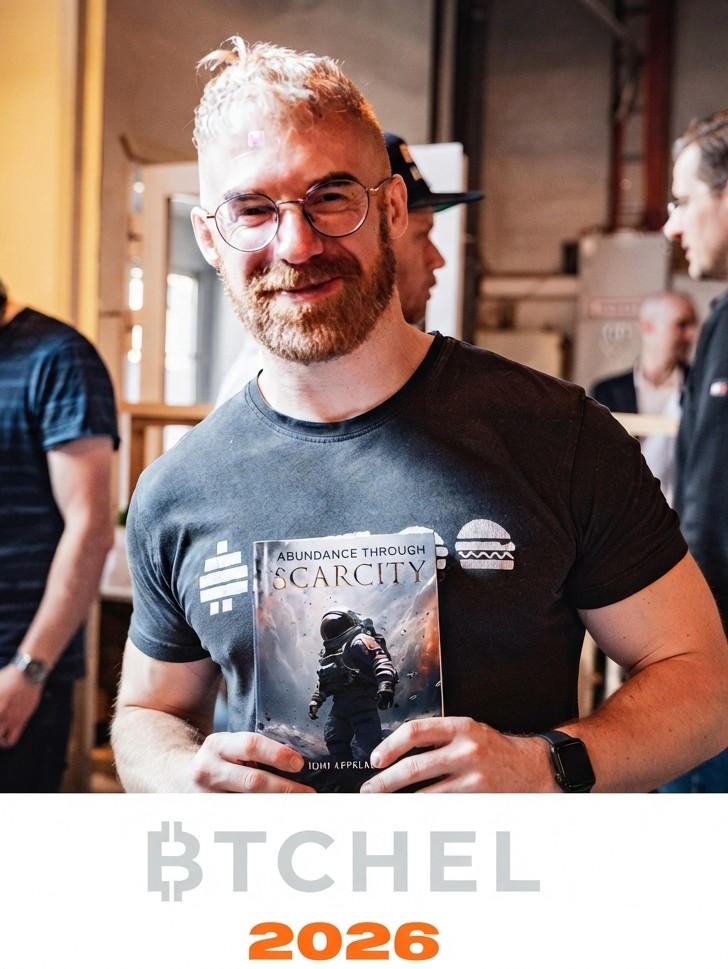
The first time I read Ioni Appelberg’s great Abundance Through Scarcity was in a D.C. hotel restaurant at the height of the last bull market. It felt celebratory and appropriately lifted my gaze from the depravity of that lost, despicable, politicized city. Money is civilization; civilization is energy; energy propels us forward, technically, and outward, spatially. Our destiny is to become a space-faring nation — or to perish.
Because I’m different, the times are different, and Ioni actually updated and revamped the book this year (meaning the book itself is different), it’s hard to tell exactly why reading Abundance this time around is an altogether different experience.
It still has the same lift-your-goddamn-gaze flavor. It’s still obsessed with space and human civilization — quite often the Roman one. It still celebrates money as this insane, improbable, incredible cooperative device between humans. It’s the silent patchwork/bind knitting us together as a species, as a civilization, as the economic collaboration that is the world economy. That the cover is a Bitcoin-clad Astronaut battling a space storm on some far-off planet is strange and unconventional, until you realize that Ioni is obsessed with humans — as a global civilization — becoming a space-faring species.
But fiat, and its increasingly broken and collapsing institutions, were not meant for the space age. “Fiat currency evolved for a different world,” (p. 227) i.e., our national (often centrally directed) economies, where coordination horizons remain short. For bigger, solar-system endeavors, we need something else:
“Trying to run a planetary civilization on institution-bound money is like trying to stream video over a fax machine. The infrastructure is not built for what we are trying to do.” (p. 227).
Then again, Bitcoin with its ten-minute block times would struggle as intergalactic or even galactic money: It’s too slow, the light years of distance between planets and solar systems in our galaxy too vast. Mars, let alone the moon, will probably resort to their own chains.
The Most Important Thing Satoshi Gave Us
Scarcity. True, unfakeable, unrivalled scarcity: “scarcity that does not depend on geology or engineering. Mathematical scarcity” (p. 103). Up until Satoshi unleashed Bitcoin on the world, everything digital was infinitely copiable. Nothing (but immediately accessible, material things) was truly ownable. The white paper’s great disruption was
“…a side effect of making one thing abundant that had previously been scarce: the ability to move value without permission” (p. 150).
What I saw this time reading the revamped Abundance was an urgency I didn’t notice last time. We are running out of time.
The rhetorical twists he uses hit like gut punches. Voyager, the hopeful satellites we (“we”) sent out at the peak of the space race, were filled with human language, whale songs, art, and some small collection of the best of what we are. Sent out for an unknown future and improbable meeting, it “keeps going, unchanged, because it was built at a moment when civilization still believed in tomorrow….
We are the ones who stopped.”
Abundance is mostly a hopeful book, the way Ioni strikes me as a hopeful, kind soul. It asks the reader to lift their gaze and consider human life and existence on a larger scale, on a longer time frame, doing something more important than your everyday life. And if it hits right, it asks the reader to work diligently for civilization’s success and thriving instead of its decline.
It’s also a doomerist, terrifying story — reminding us that what we’re doing here in Bitcoinland is much more important than number-go-up or preserving wealth from the value erosion that is money printing and inflation.
Bitcoin is here and works, but the wider public remains mostly ignorant of it — if not outright hostile. This is the sort of goldbug/black-pilled/Austrian doomerism I can get behind… fiat can, if not thrive and flourish, muddle through much longer than anyone thinks reasonable.
This has to work soon, or else (Western) civ is quite rapidly circling the drains.
Abundance through scarcity sounds like a contradiction — until you realize that some (most?) of the greatest things humanity ever achieved happened by taking away rather than adding; adding by subtraction. Via Negativa. Or, in the overarching metaphor of the book itself: Michelangelo saw — so goes the apocryphal story, anyway — his masterpiece marble sculpture “David” in a piece of inferior block, rejected by everyone else as unsuitable for crafting anything. Just take away everything that isn’t David.
Toward the very end of the book, Ioni speculates once more on the great filtering and the Fermi paradox (which I was told recently by someone working for NASA, was haphazardly written on a napkin and should be considered accordingly) that “Perhaps the Great Silence is filled with worlds that mastered energy, computation, and intelligence, yet never learned how to endure” (p. 245).
“The record persists, waiting to see whether it will become the backbone of a conversation across thousands of generations, or a root or in the ruins of another failed ascent” (p. 246).
This week, you’ll find Ioni giving a lecture on Bitcoin and longevity on Friday exclusively for the OG stage, and be part of the main stage panel session on “Sauna, Meat, and Sun: Bitcoin meets Biohackers” on Saturday.